

Handmade Wooden Lamps: What Makes Lighting Truly Sustainable
There's an idea that repeats, almost like a refrain, whenever interior design sustainability is discussed: buy less, buy better. It sounds simple. But when applied to the world of lighting, this maxim gains layers that deserve to be explored - from the origin of the raw material to the moment a piece, many years later, reaches the end of its life cycle.
In this article, we follow that path. Not as a manifesto, but as an invitation to look at a handmade wooden lamp with awareness of everything it represents: the tree it came from, the hands that shaped it, the energy it consumes, the time it lasts, and its ultimate fate. It's this complete vision that distinguishes a truly sustainable piece from a simple object with a green label.
The origin of wood: where sustainability begins
Before it was a lamp, the wood was a tree. And before it reached our hands, it traveled a path that, in itself, tells a story. Sustainability in artisanal lighting inevitably begins there - in how the raw material is found, selected, and treated.
At LAMS Woodcrafts, the wood we work with is not bought, nor do we cut down trees. It is found. Trunks, roots, and branches that weather conditions - storms, floods, persistent wind - broke and left in forests, on streets, or simply carried downstream to the sea. In the latter case, the Atlantic does the rest: it polished, shaped, tumbled each piece over and over again, until it deposited it on the sand of a Portuguese coast beach.
Driftwood: when the sea returns what the land offered
Driftwood is, perhaps, the most authentic expression of natural circularity. It wasn't planted to be exploited. It didn't require felling. It came from a tree that lived its cycle, succumbed to a storm, and began a second journey - through rivers, currents, salt, and time - until it found its destiny on a beach.
Each piece carries a unique story: organic shapes that no mold can produce, textures worked by water and sand, tones that no varnish can replicate. Collecting this wood - as we regularly do on the beaches south of the Setúbal peninsula - is not just about obtaining raw material. It is an act of observation and respect: walking on the sand, among trunks and branches shaped by the ocean, and recognizing in a form the embryo of a future piece. From this, pieces like MIRANTE, ROBUSTUS, or CATATUA are born - each faithful to the wood the sea offered, without forcing shapes that do not belong to it.

MIRANTE - driftwood found on the Portuguese coast, transformed into a wall lamp with unique and unrepeatable shapes.
Artisanal production: the opposite of planned obsolescence
If the origin of the wood is the first chapter of sustainability, the way it is worked is the second. And here, the difference between industrial and artisanal production is not just aesthetic - it's structural.
In an industrial process, efficiency is measured in units per hour. Wood is cut in series, sanded by machines calibrated for uniformity. The goal is volume. In artisanal production, the relationship with the material is reversed: it is the artisan who adapts to the piece, and not the other way around. An irregular grain becomes a design element. An unexpected curve defines the lamp's personality. The result is a piece that was not designed to be discarded - it was designed to last.
This approach has practical implications for sustainability. Material waste is significantly reduced when each piece of wood is individually assessed. The energy consumed is predominantly human, with occasional use of power tools. And the time invested in each piece translates into a durability that no assembly line replicates: more precise joints, more careful finishes, an attention to detail that, by definition, is not scalable.
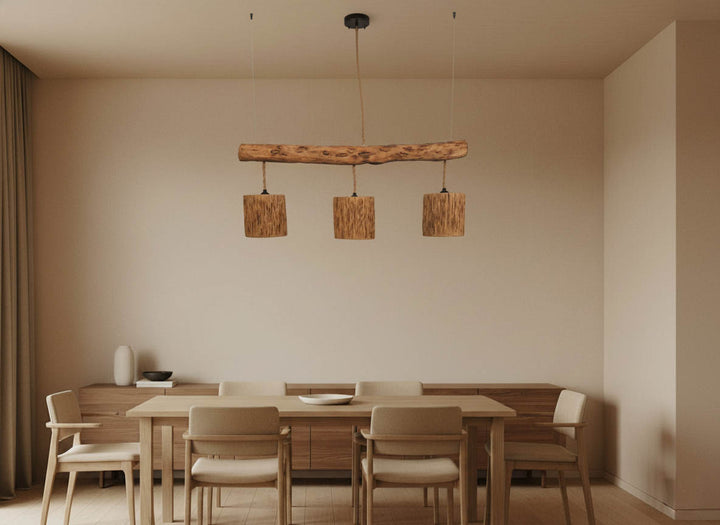
ESTEIO - the raw character of driftwood transformed into a striking ceiling lamp.
The life cycle of a solid wood lamp
The true measure of a product's sustainability is not in the label it bears, but in how long it lasts and what happens when it is no longer used. In this regard, handcrafted solid wood offers advantages that few materials can match.
Durability as a form of resistance to disposable consumption
A well-designed and well-finished solid wood lamp can accompany several generations. Wood, unlike plastic or MDF, ages gracefully - it develops a patina, gains character, becomes more beautiful with time. A small scratch is not damage: it's a memory. And, if necessary, solid wood can be sanded, treated, and restored, indefinitely extending its life cycle.
Compare this to an industrially produced lamp made of composite materials: when a component fails or the finish degrades, the entire piece is replaced. It was not designed to be repaired. It was designed to be bought again.

ROBUSTUS - the name says it all. Driftwood that survived currents and time, now with decades of indoor life ahead.
End of life: biodegradability and heritage
When, eventually, a wooden lamp reaches the end of its usefulness, the wood does not become problematic waste. It is a natural, biodegradable material that can be reused, transformed into another object, or returned to the earth without significant environmental impact. The treatments used on quality artisanal pieces tend to be natural oils and waxes - not synthetic paints or toxic varnishes that complicate recycling.
But there is a more beautiful and more likely scenario than discarding: heritage. A unique piece, with history and personality, tends to be preserved. It passes from hand to hand, from home to home, keeping alive the value of the wood and the work that transformed it. It is, perhaps, the most elegant form of sustainability: the piece that never becomes trash because it never loses value.
Lighting and energy consumption: the complete equation
The sustainability of a lamp does not end with its structure. The lighting technology it uses is equally decisive. The option for low-consumption LED bulbs - compatible with most handmade wooden lamps - drastically reduces the energy impact during the years of use, which are, in practice, the longest phase of the product's life cycle.
A quality LED, combined with a wooden base that will last for decades, represents an investment whose environmental amortization is incomparably more favorable than that of a cheap lamp that will be replaced every two or three years. Sustainability, here, is not just the material - it is the sum of the material, durability, and energy efficiency over time.

LUMI - warm and efficient light in a handmade wooden structure designed to last.
How to choose artisanal lighting with sustainable criteria
If you want to integrate sustainable lighting into your home or interior design project, there are some criteria that can guide your choice.
The first is the transparency of origin. A manufacturer who identifies the woods they use, explains their production process, and shows the work behind each piece offers a guarantee of authenticity that no generic seal replaces.
The second is the timelessness of design. A piece designed to transcend trends does not become obsolete when fashion changes - and this resistance to discarding is, in itself, an act of sustainability.
The third is repairability. Choose pieces whose construction allows for maintenance: replacement of electrical components, wood treatment, adjustments over time. A piece that can be repaired is a piece that does not need to be replaced.
And finally, the story the piece tells. A lamp with a known origin, made by identifiable hands, with a journey that can be recounted, has an emotional value that naturally protects it from being discarded. You don't throw away something to which you attribute meaning.

ABRAÇO - each piece has a name, an origin, and a story. It is precisely this meaning that makes it irreplaceable.
---
At LAMS Woodcrafts, every lamp we create is born from this conviction: that the most beautiful lighting is also the most responsible. If you share this vision, we invite you to discover our pieces - each with its wood, its story, its light. And if you want to know more about who we are and how we work, visit our page.